Company Logo

GST Billing vs Traditional Billing: Which One is Right for You?

Sahil Duragiya

Sahil Duragiya,

Nov 07, 2025

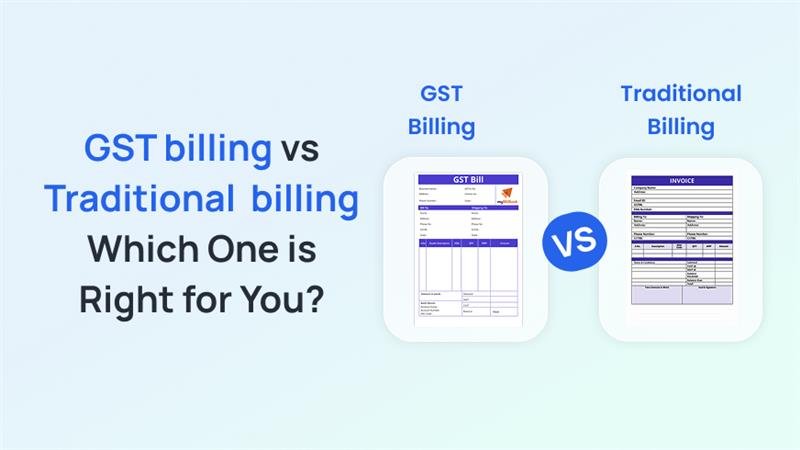
GST Billing vs Traditional Billing

Effective billing and invoicing management is crucial for smooth financial operations in a fast-paced and fiercely competitive business environment. Correct billing ensures proper cash flow, reduces errors, and builds credibility with clients. Despite the digital transformation of taxation systems, businesses are increasingly turning to automated GST billing solutions instead of manual processes. With the implementation of the Goods and Services Tax (GST) in India, which aims to make the tax system more straightforward and transparent, this change has become even more significant.

As a result of this shift, numerous companies are now debating whether to utilise GST or use traditional billing methods. The use of traditional billing, which primarily involves the generation of manual invoices, handwriting on paper, or simple formats without tax compliance, makes it ideal for small or unregistered businesses. In contrast, GST billing is a modern technology-based system that automatically computes taxes, generates invoices compliant with GST regulations, and links up with government portals for filing returns. Your business's size, tax registration status, and operational requirements all determine whether to choose one or the other. We'll go over the key differences, benefits and challenges of both systems and guide which one to choose for your business in the subsequent sections.

What is Traditional Billing?

Before the implementation of GST (Goods and Services Tax) in India, businesses relied on the traditional billing system, which operated under multiple indirect tax regimes such as VAT (Value Added Tax), Service Tax, Excise Duty, Sales Tax, and Entry Tax. Each of these taxes had its own set of rules, rates, and compliance requirements, which made the billing process complicated and time-consuming. Traditional billing was primarily manual or semi-digital, meaning invoices were created by hand or using simple tools like Microsoft Excel, Word templates, or basic accounting software. This system required business owners to manually calculate taxes and maintain separate records for different state and central taxes.

While traditional billing served the needs of small and medium businesses for many years, it had several limitations in terms of accuracy, transparency, and efficiency. Since most calculations were done manually, there was a high chance of mathematical errors, tax miscalculations, and even fraudulent entries. Moreover, businesses had to maintain separate ledgers and paperwork for each tax type, which made compliance and audit processes extremely tedious. With the introduction of GST, this fragmented system became obsolete, as the new unified tax structure demanded automation, accuracy, and real-time reporting — something traditional billing could not deliver effectively.

Key Features of Traditional Billing

Manual Invoice Preparation:

Invoices were typically generated by hand or with simple equipment, necessitating manual entry of buyer information, product lists, prices, and taxes. Besides taking up time, this increased the likelihood of errors.

Tax Calculations For Every Product or Service:

Under the old tax regime, different goods and services attracted different taxes. Businesses had to calculate VAT, Service Tax, or Excise Duty separately, depending on the nature of the transaction. This often led to confusion and inconsistent pricing.

Time-Consuming Record-Keeping:

It required a great deal of effort and storage space to maintain and organise physical files for sales, purchases, and tax records since all transactions were manually recorded. It was also difficult to retrieve old records when performing audits or reconciliations.

Limited Tax Transparency:

Customers often had no clear understanding of how much tax was being charged or to which department it was paid. The system lacked transparency, which sometimes led to tax evasion or double taxation.

Prone to Human Errors and Fraud:

Manual systems are naturally vulnerable to calculation mistakes, missing entries, and data manipulation. Without a digital audit trail, it was difficult to detect discrepancies or fraudulent practices.

What is GST Billing?

After the introduction of the Goods and Services Tax (GST) in India in 2017, the entire taxation and billing landscape underwent a revolutionary change. GST replaced a complex system of multiple indirect taxes like VAT, Service Tax, Excise Duty, and Sales Tax, and merged them into one unified tax structure. This simplification made tax compliance easier and brought uniformity across states and business sectors. GST Billing is a modern, digital billing system that ensures every invoice generated by a registered business complies with GST laws and includes all the necessary details, such as GSTIN (Goods and Services Tax Identification Number), invoice number, HSN/SAC codes, taxable value, applicable tax rates, and total payable tax amount.

Unlike traditional billing, where manual effort and multiple tax calculations created confusion, GST billing automates the entire process. It ensures transparency, reduces errors, and integrates seamlessly with government GST portals for real-time filing and return submissions. Businesses using GST billing software can easily generate invoices, track transactions, manage inventory, and maintain accurate tax records-all from one platform. This has not only simplified accounting but also strengthened India's digital economy by encouraging businesses to adopt smarter, technology-driven billing systems.

Key Features of GST Billing:

Automated Calculation of CGST, SGST, and IGST:

GST billing software automatically calculates the correct type and percentage of tax - CGST, SGST, or IGST - based on the location of the buyer and seller. This eliminates the need for manual tax computation, ensuring accuracy and compliance with government tax slabs.

Real-Time Tax Filing and Return Synchronisation:

Modern GST billing systems are integrated with GSTN (Goods and Services Tax Network), enabling businesses to upload invoices directly, file returns, and sync data in real time. This saves time and minimises the chances of filing errors or missed deadlines.

HSN/SAC Code Integration for Products and Services:

Each product or service under GST is categorised using HSN (Harmonised System of Nomenclature) or SAC (Service Accounting Code). GST billing software automatically associates these codes with your invoices, making classification easier and ensuring compliance during audits or filings.

Digital Invoice Generation and E-Invoicing Support:

Invoices generated through GST billing software can be authenticated by the GST portal and processed digitally, as it is now standard practice for government e-invoicing. Authenticity, traceability and accuracy are guaranteed in every transaction.

Easy Audit Trail and Record Management:

Every invoice, tax payment, and transaction is stored digitally, creating a transparent audit trail. This helps during government audits or business reconciliations and reduces the hassle of maintaining physical files.

Key Differences Between GST Billing and Traditional Billing

The following table highlights the major differences between GST Billing and Traditional Billing systems:

Aspect Traditional Billing GST Billing
Tax System Multiple indirect taxes (VAT, Service Tax, etc.) Unified tax system (CGST, SGST, IGST)
Invoice Format No fixed Structure Standardised GST invoice format
Compliance Manual Compliance Automatic GST Compliance
Technology Manual or basic software Cloud-based GST billing software
Accuracy High risk of human errors Automated tax calculation ensures accuracy
Transparency Difficult to track taxes Clear and transparent tax structure
Record Keeping Physical files and papers Digital and cloud-based storage
Filing Process Separate returns for each tax Single online GST return filing

Advantages of GST Billing (Explained in Detail)

Simplified Taxation – One Nation, One Tax:

GST replaces multiple indirect taxes like VAT, Service Tax, Excise Duty, and Sales Tax with a single unified tax system. This eliminates the complexity of calculating and paying different taxes for the same transaction. Businesses no longer need to track separate tax rates for each state or product, making accounting simpler and reducing the risk of errors.

Increased Transparency:

Digitally recorded transactions are made possible for tracking every GST invoice on the GSTN portal. This ensures that all transactions can be traced. By doing this, the government and businesses can keep track of every transaction transparently and without any red tape, thereby reducing the risk of tax fraud, duplicate billing, or unreported sales.

Faster Invoicing:

GST billing software automates invoice generation, instantly calculating taxes, applying discounts, and formatting invoices as per GST norms. This significantly reduces the manual workload, allowing employees to focus on more critical tasks and ensuring faster turnaround times for billing clients.

Better Accuracy:

Human errors are common in traditional billing systems, especially when calculating multiple taxes manually. GST billing software automatically calculates CGST, SGST, and IGST, applies the correct HSN/SAC codes, and generates error-free invoices. Accurate billing prevents disputes with clients and reduces compliance risks during audits.

Improved Cash Flow Management:

Businesses can use automated GST billing to track receivables, pay, and file returns. Proper tax filing ensures compliance and avoids penalties, while precise invoices enable businesses to manage their finances and cash flow more effectively, thereby enhancing their liquidity and operational efficiency.

Disadvantages of Traditional Billing

Complex Tax Calculations:

The multiple indirect taxes, such as VAT, Service Tax, Excise Duty, and Sales Tax, managed by businesses before the GST implementation, needed separate calculations due to their different rates and rules for each tax category (goods, services, and manufacturing activities). The inevitable confusion, double taxation, and mistakes in calculation were the results of such intricate taxation. In addition, manually monitoring the varying tax rates and exemptions turned tax filing into a labour-intensive and lengthy process.

Lack of Standardisation:

In traditional billing, there was no uniform format for invoices. Each business designed its own bill template, often missing essential details like tax registration numbers or itemised tax breakdowns. This lack of consistency made it difficult for customers, auditors, and tax officials to verify and process invoices. It also led to communication gaps between businesses and clients, causing delays in payments and misunderstandings.

Manual Errors:

Most of the time, traditional bills were created either by hand or with very basic tools such as Excel or Word; hence, they were very much susceptible to human errors, from wrong tax calculations to data entry errors. Even tiny mistakes could result in the difference of records, unintentional financial losses, or non-compliance risks in the course of audits. The reliability and trustworthiness of the business gradually suffered due to the frequent occurrence of errors.

No Integration with Digital Systems:

The traditional billing systems could not work hand in hand with modern accounting or tax filing software. The businesses had no choice but to manually transfer data between systems for bookkeeping, inventory management or tax filing when they lacked the systems' integration. The whole process not only took extra time but also increased the risk of data discrepancies and loss. GST billing systems, on the other hand, made automatic data synchronisation for real-time reporting possible.

Which One is Right for You? (Explained in Detail)

Deciding between GST Billing and Traditional Billing depends on the nature, size, and compliance needs of your business. Both systems have their own relevance, but in today's digital and regulated market, one clearly offers more long-term advantages. Let's look at when each option makes sense for your business:

Choose GST Billing if:

Your Business is Registered Under GST:

If your annual turnover exceeds the GST threshold limit (₹40 lakhs for goods and ₹20 lakhs for services in most states), you are legally required to register under GST. In such cases, using GST billing software is not just convenient — it's mandatory. It helps you generate GST-compliant invoices with all required details like GSTIN, HSN/SAC codes, and tax breakdowns, ensuring your business stays legally compliant.

You Need Accurate and Compliant Invoices:

GST billing calculates taxes automatically, thus minimising the likelihood of errors and wrong calculations. The program guarantees that each invoice is compliant with the government's requirements and assists you in not incurring penalties or disallowances during audits or tax returns. Proper billing also enhances your business's reputation and customer loyalty.

You Want to Save Time and Automate Billing:

GST Billing was once a manual process that involved a lot of paperwork and took a lot of time. Automation of the entire billing process, including invoice generation, tax calculation, e-filing, and report making, is one of the repetitive tasks done by the billing software. Consequently, it not only saves time but also increases productivity, particularly in the case of large organisations that deal with a high volume of transactions.

You Plan to Grow Your Business Digitally:

If you're planning to expand your business, sell online, or operate across states, GST billing is essential. It integrates easily with digital accounting, inventory management, and e-commerce platforms, ensuring smooth operations and scalability. GST billing also enables real-time data synchronisation with GST portals, making it ideal for future-focused, digitally-driven businesses.

Stick with Traditional Billing only if:

Your Business is Not Registered Under GST:

Small or unregistered businesses that don't fall under the GST threshold limit can continue with traditional billing methods. For such small-scale operations — like local vendors, freelancers, or micro-businesses — simple handwritten or Excel-based invoices may still suffice, as GST compliance is not mandatory.

You Deal with Limited Transactions and Manual Records are Manageable:

If your business handles only a few transactions per month and doesn't require digital records or complex tax filings, traditional billing can still work. However, even in this case, businesses should consider gradually moving to basic digital billing tools, as they offer better record-keeping and long-term convenience.

How GST Billing Software Like VirvaBook Helps (Explained in Detail)

In today's business environment, where accuracy, speed, and compliance are essential, relying on manual or outdated billing methods can slow down your growth. That's where Virva Book GST Billing Software comes in — an all-in-one digital billing solution designed to simplify your invoicing, tax filing, and accounting operations. Whether you're a small business, retailer, wholesaler, or service provider, VirvaBook helps you transition smoothly from traditional billing to a modern GST-compliant system.

VirvaBook not only automates your tax calculations but also brings complete transparency, real-time insights, and secure data management to your business processes. Let's take a closer look at its powerful features and how they make a difference:

Key Features of VirvaBook (Explained in Detail):

Auto GST Calculation for Every Invoice:

VirvaBook takes care of the computation of CGST, SGST, and IGST automatically, according to the location of your buyer as well as the seller. Thus, manual tax calculation is done away with, and each invoice is 100% compliant with GST. Through its built-in tax logic, the system helps to eliminate calculation errors and thus delivers the right results and abides by the latest GST requirements.

Easy Generation of E-Invoices:

The government has made it compulsory for many companies to conduct e-invoicing. With VirvaBook, this process is made easy as you can generate and upload e-invoices to the GST portal directly in just a few clicks. Each e-invoice is tagged with a unique IRN (Invoice Reference Number) and a QR code, thereby making your invoicing process not only efficient but also fully compliant with the government standards.

Real-Time Inventory and Expense Tracking:

Keeping track of your stock and expenses manually can be challenging. VirvaBook offers real-time inventory management, helping you monitor product availability, purchase history, and sales performance. You can also track expenses easily, identify cost leaks, and make better financial decisions — all from a single dashboard.

Customer and Supplier Management:

VirvaBook helps you maintain a detailed database of your customers and suppliers, including contact information, GSTIN numbers, transaction history, and outstanding balances. This makes it easier to manage relationships, send payment reminders, and keep your cash flow healthy.

Cloud Backup and Data Security:

With VirvaBook, you never have to worry about losing your data. It offers secure cloud backup, meaning your invoices, reports, and client details are safely stored and can be accessed anytime, anywhere. Strong encryption ensures your sensitive financial data remains protected from unauthorized access or cyber threats.

Conclusion

The contrast between GST Billing and Traditional Billing reveals that GST Billing is the most efficient, accurate, and ready for the future. Traditional billing might continue to be used in some small businesses, but it is quickly going out of use in the modern business environment.

If you get a trustworthy GST Billing Software such as VirvaBook, you will be able to make your operations easier, keep up with the GST regulations, and still have time for business growth with complete assurance.

👉 Want to create professional GST-compliant invoices in seconds? Try our free invoice generator software to quickly generate both proforma and tax invoices online!