
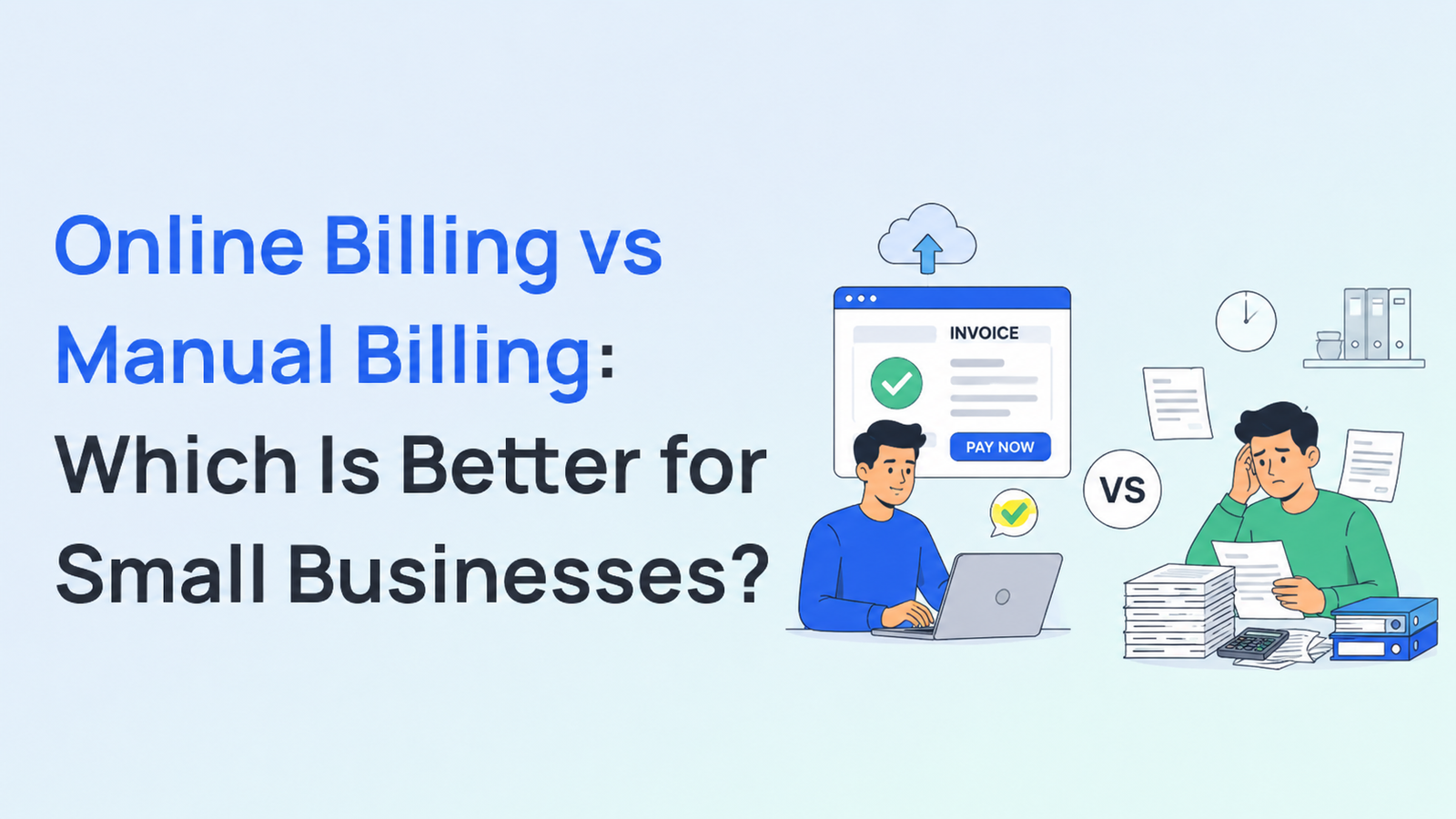

If you run a small business in India, you already know that billing is not just about writing an amount on a piece of paper. It is about getting paid on time, staying GST compliant, keeping your customers happy, and having clean records for the day your CA asks for them.
For years, most small shop owners, traders, and service providers in India have relied on manual billing — a notebook, a printed bill book, or an Excel sheet. But today, more and more businesses are shifting to online billing software. So the real question is: which one is actually better for your business in 2026?
In this blog, we will break down online billing and manual billing in simple, easy-to-understand language, compare them side by side, and help you decide what suits your business best.
What Is Manual Billing?
Manual billing is the traditional way of creating invoices — using a printed bill book, a diary, or even a basic Excel or Word file. Many small businesses across India still use this method because it feels familiar, does not need internet or technical knowledge, and has almost zero starting cost.
In manual billing, every invoice is written or typed by hand, calculations are done manually or with a calculator, and records are stored physically in files or folders. It has worked for decades, and for very small, low-volume businesses, it can still get the job done.
What Is Online Billing?
Online billing, also called digital billing or online invoicing, means creating, sending, and managing your invoices through billing software or an app — like Virvabook. Instead of writing bills by hand, you enter the product or service details, and the software automatically calculates the total, applies GST, and generates a professional invoice in seconds.
Online billing software also stores all your invoices safely on the cloud, so you can access them anytime, from anywhere — your shop, your home, or even your phone while travelling.
Online Billing vs Manual Billing: The Key Differences
| Factor | Manual Billing | Online Billing |
|---|---|---|
| Time taken per bill | 5–10 minutes | Under 1 minute |
| Calculation errors | Common | Almost zero |
| GST compliance | Manual and risky | Automatic and accurate |
| Data storage | Physical; can be lost or damaged | Cloud-based, safe and backed up |
| Access from anywhere | Not possible | Possible, on mobile or laptop |
| Customer records | Hard to track | Organised and searchable |
| Professional look | Basic | Branded, professional invoices |
| Cost | Low upfront, high in errors and time | Affordable monthly plans, saves time |
This table alone shows why so many small businesses in India are rethinking their billing process.
Advantages of Online Billing for Small Businesses
1. Saves Time, Every Single Day
When you have ten or twenty customers a day, manually writing each bill adds up to hours of work every week. Online billing software fills in customer and product details automatically, so you can generate a bill in seconds instead of minutes.
2. Reduces Human Errors
A small mistake in manual calculation — a wrong total, a missed discount, or an incorrect GST rate — can cost your business money and trust. Online billing software calculates everything automatically, which means fewer disputes with customers and cleaner accounts.
3. Makes GST Filing Much Easier
This is one of the biggest reasons Indian businesses are moving to online billing. GST-compliant invoicing software like Virvabook automatically applies the correct tax rates, generates GST-ready invoices, and keeps your data organised for return filing. This alone can save hours of stress every month. If you're just getting started, check out our step-by-step guide on How to Create GST Bills Online for Free.
4. Keeps Your Business Records Safe
Paper bills can be torn, misplaced, or damaged by water, fire, or pests. With online billing, invoices are stored safely on the cloud, so you never lose important business data.
5. Gives a Professional Image
A neat, branded digital invoice with your business logo builds more trust than a handwritten bill, especially when you deal with businesses, distributors, or customers who expect professionalism.
6. Helps You Track Payments and Dues
Good online billing software shows which invoices are paid, which are pending, and who owes you money — all in one dashboard.
7. Access Anytime, Anywhere
Whether you are at your shop, at home, or travelling for business, online billing lets you check records, generate a bill, or send an invoice from your mobile phone.
Challenges of Manual Billing
While manual billing feels simple at first, it comes with hidden costs that many small business owners realise only later:
Time-consuming: Writing, calculating, and organising bills by hand takes far longer than most owners realise.
Prone to errors: A single wrong calculation can lead to incorrect GST filing and possible penalties.
Risk of data loss: Bill books can be lost, torn, or damaged, taking your business history with them.
Difficult to analyse: You cannot easily see monthly sales, best-selling products, or pending payments from a stack of paper bills.
Not scalable: As your business grows, manual billing becomes harder and harder to manage.
When Might Manual Billing Still Work?
Manual billing is not always the wrong choice. If you run a very small, low-volume business — say, a handful of transactions a week — and you are not registered under GST, a simple bill book might still be manageable for now. However, even in such cases, most businesses eventually find that shifting to online billing early saves them from a messy transition later.
Why Indian Small Businesses Are Increasingly Choosing Online Billing
India's business environment has changed a lot in the last few years. With GST compliance now mandatory for most registered businesses and digital payments becoming the norm, having accurate, well-organised invoices is no longer optional — it is essential.
Banks and lenders also prefer businesses with clean digital records when approving business loans. Customers increasingly expect professional invoices, especially in B2B transactions. This is pushing small businesses toward reliable online billing software that fits the Indian business context.
How Virvabook Makes Online Billing Simple for You
Virvabook is built specifically for small businesses in India who want billing to be simple, fast, and stress-free. With Virvabook, you can:
Create GST-compliant invoices in under a minute.
Automatically calculate taxes and totals with zero manual effort.
Store all invoices and customer data safely on the cloud.
Track pending and completed payments in one place.
Access your billing dashboard from your phone or laptop, anytime.
Whether you run a retail shop, a service business, or a small trading firm, Virvabook is designed to remove the daily hassle of billing so you can focus on growing your business.
If you want to understand invoicing software in more detail, read our complete guide to invoice software for small businesses.
Once you've decided to move away from manual bill books, it also helps to see how a complete system organises your entire billing workflow, not just individual invoices. Our blog on Digital Invoice Management Systems for Small Business explains this in detail.
Making the Right Choice for Your Business
At the end of the day, the choice between online billing and manual billing comes down to how much you value your time, accuracy, and peace of mind. Manual billing might feel familiar, but it comes with hidden risks — lost records, calculation errors, and GST complications. Online billing offers speed, accuracy, safety, and a more professional image for your growing business.
If you are still billing manually and finding it harder to manage as your business grows, it may be the right time to make the switch. With tools like Virvabook, moving to online billing is easier than you think, and the benefits show up almost immediately — in saved time, fewer errors, and better control over your business.