Company Logo

Proforma Invoice vs Tax Invoice: Key Differences Explained
${post.author}

Sahil Duragiya,

Aug 08, 2025

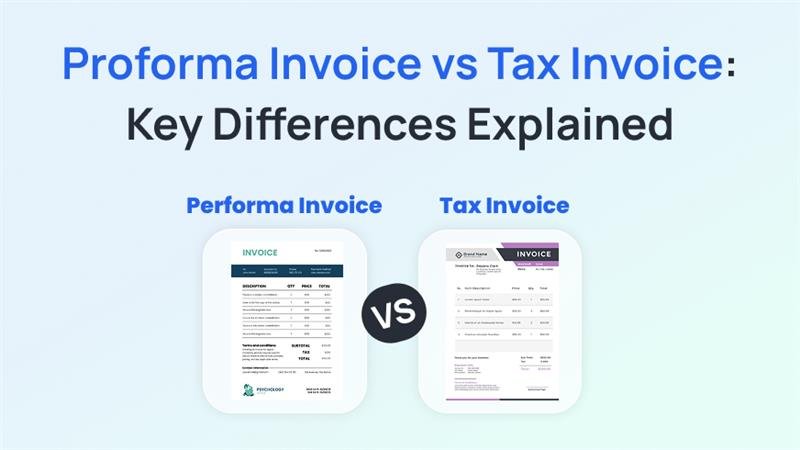
When you step into the world of business—whether as a budding entrepreneur, a freelancer, or a small business owner—you quickly realise that paperwork plays a huge role in keeping things running smoothly. Among the many documents you encounter, proforma invoices and tax invoices often stand out as two that look almost identical at first glance. This similarity can easily confuse, especially for those new to handling business transactions.

However, despite their visual resemblance, the purpose, timing, and legal standing of a proforma invoice versus a tax invoice are entirely different. Understanding these differences is crucial, not only for ensuring smooth financial operations but also for maintaining compliance with tax regulations and professional credibility with clients.

Key Differences Between a Proforma Invoice and a Tax Invoice

Aspect Proforma Invoice Tax Invoice
Purpose A preliminary bill or estimate, sent before goods/services are delivered An official document requesting payment for delivered goods/services
Timing Issued before the transaction Issued after the transaction
Legality Not a legally binding document Legally recognised for tax and accounting
Payment Status Does not confirm payment Used for collecting payment
Tax Inclusion May or may not include tax details Must include applicable taxes (e.g., GST, VAT)
Accounting Use Not recorded in books Recorded in official accounting records

What is Proforma Invoice?

A proforma invoice is essentially a preliminary bill issued to the buyer before the delivery of goods or services. It serves as a formal quote or estimate, providing the buyer with a clear understanding of the expected costs, product specifications, and delivery timelines. Unlike a final invoice, it does not demand immediate payment or serve as a legally binding document—it is primarily for informational and planning purposes. Businesses often use proforma invoices to ensure that both parties are on the same page before proceeding with the transaction.

Key points about a proforma invoice:

What is Tax Invoice?

A tax invoice is an official document issued by the seller after goods or services have been delivered. It serves as a formal request for payment and is a key part of most business transactions. Beyond being a payment demand, it is also a legal requirement in many countries for tax reporting and compliance purposes. A tax invoice confirms that a sale has taken place and specifies the amount of tax (such as GST, VAT, or Sales Tax) applicable to the transaction. Because it has legal validity, it is used by both sellers and buyers for accounting and taxation purposes.

Key points about a tax invoice:

How Does a Proforma Invoice Work?

Buyer requests a quotation - The process begins when a buyer asks the seller for an estimated cost of goods or services.

Seller issues a proforma invoice - This document includes tentative prices, quantities, product details, and delivery terms for the buyer's review.

Buyer reviews and negotiates - The buyer can either approve the proposal or request adjustments to prices, quantities, or terms.

Order confirmation and delivery - Once both parties agree, the seller delivers the goods or services.

Tax invoice issued - After delivery, the seller issues a tax invoice for official payment collection and tax compliance.

A proforma invoice acts as a bridge between inquiry and final sale. It ensures both the buyer and seller are aligned on pricing, quantity, and delivery terms before the actual transaction takes place. This reduces misunderstandings, speeds up decision-making, and lays the groundwork for smooth payment processing later.

How Does a Tax Invoice Work?

Seller delivers goods or completes the agreed services - The tax invoice process starts only after the actual delivery of products or completion of services.

Seller issues a tax invoice - This document includes mandatory details such as seller and buyer information, invoice number, date, product or service description, quantity, unit price, applicable taxes (e.g., GST at 18%), and total payable amount.

Buyer makes payment - The buyer settles the payment according to the terms mentioned in the tax invoice, which may include specific due dates or payment methods.

Seller records the invoice - The issued tax invoice is entered into the seller's official accounting records for revenue tracking and tax reporting purposes.

Used for tax compliance - The tax invoice serves as proof of sale and enables the buyer to claim input tax credit under GST, VAT, or similar tax systems.

A tax invoice is the official payment request issued after goods or services are delivered. It not only facilitates payment collection but also ensures legal and tax compliance for both parties, making it a crucial document in business transactions.

Advantages of Proforma Invoice vs Tax Invoice

Advantages of a Proforma Invoice

(1) Helps in price negotiation before the sale

A proforma invoice allows buyers and sellers to discuss and agree on pricing, quantities, and terms before the transaction, ensuring both parties are satisfied.

(2) Useful for international trade documentation

In global trade, proforma invoices are often required for customs clearance and import/export documentation, helping smooth the shipment process.

(3) Provides clarity on expected costs

It lists estimated prices, product details, and delivery terms so buyers can make informed purchasing decisions without surprises.

(4) Prevents disputes before final billing

By outlining all transaction details in advance, disputes can be avoided and miscommunication prevented.

Advantages of Tax Invoice

(1) Legally valid for tax purposes

A legal document required to pay taxes, such as those related to GST or VAT, in many countries.

(2) Helps claim input tax credit

Buyers can use tax invoices to claim back taxes paid on purchases, reducing their overall tax liability.

(3) Serves as proof of sale and payment request

It formally confirms that a sale has taken place and provides the buyer with an official payment demand.

(4) Required for official accounting and audits

Tax invoices are recorded in business accounts and serve as key evidence during financial audits and compliance checks.

Disadvantages of a Proforma Invoice vs a Tax Invoice

Disadvantages of a Proforma Invoice

(1) Not legally enforceable

Proforma invoices are not legally binding, as they are only a quotation or estimate and cannot be used as proof of completed sales.

(2) Cannot be used for a tax credit claim

Buyers cannot claim GST, VAT, or similar input tax credits using a proforma invoice, as it is not an official tax document.

(3) May create confusion if mistaken for a final bill

Miscommunication between buyers and sellers can arise if a proforma invoice is not clearly identified as preliminary, leading to confusion.

Disadvantages of Tax Invoice

(1) Must comply with strict tax regulations

Tax invoices must meet specific legal requirements, and failure to include mandatory details can render them invalid.

(2) Errors can lead to penalties or delayed payments

Inaccurate tax calculations, formatting errors, or compliance issues can lead to penalties or payment delays.

(3) Needs proper accounting software to manage efficiently

Businesses with high turnover must use accounting software to streamline their operations, as manually creating and tracking tax invoices can be time-consuming and error-prone.

Conclusion

Both proforma invoices and tax invoices play important but very different roles in business transactions. A proforma invoice works as a preliminary document that provides transparency on costs, quantities, and terms before the sale, making it especially useful for negotiations and international trade. On the other hand, a tax invoice is a legally binding document issued after delivery, serving as proof of sale, a payment request, and a key record for tax and accounting purposes.

For smooth operations, entrepreneurs, freelancers, and small business owners should use a proforma invoice to set expectations upfront and a tax invoice to finalise the transaction and remain compliant with tax laws. Understanding when and how to use each not only avoids confusion but also builds trust with clients and ensures proper financial management.

👉 Want to create professional invoices in seconds? Try our free invoice generator software to quickly generate both proforma and tax invoices online!